



The development trend of welding technology
Jul 09, 2024
Leave a message
1. Improving welding productivity is an important driving force for promoting the development of welding technology
There are two ways to improve productivity: firstly, to increase the welding deposition rate, such as three wire submerged arc welding, with process parameters of 220A/33V, 1400A40V, and 1100A45V. By using a small groove section and setting up a baffle or liner at the back, 50-60mm steel plates can be fully welded in one go, with a welding speed of over 0.4m/min. The deposition rate is more than 100 times higher than that of electrode arc welding. The second approach is to reduce the groove section and metal deposition, and the most prominent achievement is narrow gap welding. Narrow gap welding is based on gas shielded welding, using single wire, double wire, or triple wire for welding. Regardless of the thickness of the joint, butt welding can be used. For example, if the thickness of the steel plate is 50-300mm, the gap can be designed to be about 13mm. Therefore, the required amount of deposited metal is reduced by several times or tens of times, greatly improving productivity. The main technical key of narrow gap welding is to ensure the fusion of both sides and the automatic tracking of the arc center on the groove centerline. Therefore, various countries around the world have developed different schemes, resulting in the emergence of various narrow gap welding methods.
During electron beam welding, plasma welding, and laser welding, butt joints can be used without the need for beveling, making it a more ideal narrow gap welding method. This is also one of the reasons why it is widely valued.
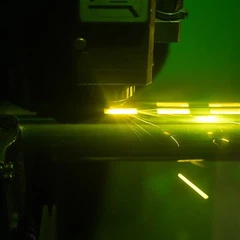
The latest developed laser arc composite welding method can improve welding speed, such as 5mm steel or aluminum plates, with a welding speed of 2-3m/min, achieving good forming and quality, and small welding deformation.
2. Improving the mechanization and automation level of the preparation workshop is a key development direction for advanced industrial countries in the world.
In order to improve the production efficiency and quality of welded structures, there are certain limitations to only focusing on welding processes. Therefore, countries around the world attach great importance to the technological transformation of workshops. The main processes of preparing the workshop include material transportation, surface degreasing of materials, sandblasting, and application of protective paint; Marking, cutting, and chamfering of steel plates; Assembly and anchoring of components. The above processes have all been mechanized and automated in modern factories. Its advantage is not only to improve the productivity of the product, but more importantly, to enhance the quality of the product.
3. Automation and intelligence of the welding process are important directions for improving the stability of welding quality and solving harsh working conditions.
4. The development of emerging industries continues to drive the advancement of welding technology.
Welding technology has a history of over a hundred years since its invention, and it can almost meet the production and manufacturing needs of all important products in the current industry. However, the development of emerging industries still forces welding technology to constantly advance. The development of microelectronics industry promotes the development of micro connection technology and equipment; For example, the development of ceramic materials and composite materials has promoted vacuum brazing and vacuum diffusion welding. The development of aerospace technology will also promote the development of space welding technology.
5. The research and development of heat sources are the fundamental driving force behind the development of welding processes.
The welding process almost utilizes all available heat sources in the world, including flames, arcs, resistors, ultrasonic waves, friction, plasma, electron beams, laser beams, microwaves, etc. (our company mainly focuses on automatic welding equipment for arc welding and resistance welding). The emergence of each type of heat source in history has been accompanied by the emergence of new welding processes. However, the development and research of welding heat sources have not yet ceased.
6. Energy saving technology is a widely concerned issue
As is well known, welding consumes a lot of energy. Taking electrode arc welding as an example, each unit has about 10KVA, submerged arc welding machine has 90KVA, and resistance welding machine can reach thousands of KVA. The emergence of many new technologies is aimed at achieving this energy-saving goal. In resistance spot welding, by utilizing the development of electronic technology, the AC spot welding machine can be replaced with a secondary rectifier spot welding machine, which can improve the power factor of the welding machine and reduce the welding machine capacity. A 1000KVA spot welding machine can be reduced to 200KVA while still achieving the same welding effect. The emergence of inverter welding machines is another successful example, which can reduce the weight of welding machines, improve the power factor control performance of welding machines, and has been widely used in production.
Send Inquiry